 |
| Panorama, 4/10/2020 15:37 |
Friday, April 10, 2020
North Elevation
Here's a full size north elevation of the house for paint and other purposes. The centerpoint is the walkway, just past the post light.

Grays
Peggy suggests the quiet sophistication of grays for the exterior color scheme. Because white fascia seems to work, and Acier doesn't seem neutral enough (too warm?), we need a coordinating set of grays.
Here's the set from the most recent discussion of exterior colors with some basic choices:

Here's the set from the most recent discussion of exterior colors with some basic choices:
- Vertical siding (Gray)
- Horizontal siding (Gray)
- Chair rail (Gray)
- Door/Window trim (White)
- Garage doors (Darker Gray)
- Garage door trim (White)
- Downspouts (Gray)
- Gutters (White)
- Fascia board (White)
- Eaves (White)
This boils down to:
- White: Trim, Fascia, Eaves, Gutters
- Gray: Vertical and Horizontal Siding, Downspouts
- Darker Gray: Garage Doors
Alternates: 1) Make the garage doors a Lighter Gray; 2) Use two grays for vertical and horizontal.
Gray Screen (7071) seems like a solid medium cool gray, LRV 59. A darker gray from the same card (235) is Software (7074). Software is LRV 23--that's very dark. S-W seems to suggest Site White (7070) to coordinate with Gray Screen. At LRV 73. it is lighter than Gray Screen, but not really a bright white. If we wanted Alternate 1 (lighter garage doors), maybe we go with Site White for that.

Thursday, April 9, 2020
White roof trim?
A lot of homes in the area have white trim/gutters at the roof. I wonder what it would look like on this house? We could use the lightening effect, but would it accentuate the old, battered gutter and would it look okay with the dark gray shingles?
To better visualize, I painted a test section with white primer. I think I like it. I also don't think the dents in the gutters are any more or less noticeable.
 |
| Test (right) of white trim on Acier wall |
 |
| The gutters and fascia are not in great shape. |
 |
| Here's an example from 12233 9th Ave NW. I plan to paint the downspouts to match the wall, however. |
Wednesday, April 8, 2020
Front Door

I like something simpler, more Shaker, which will go with the simple painted woodwork I'm planning for the living room. I'm still inspired by the easy, casual look of Shutters at the Beach.
I'm not planning to add side lights (there's no room, anyway), nor do I want to try to reshape the house as Mission or Craftsman, but some of those details wouldn't bother me.
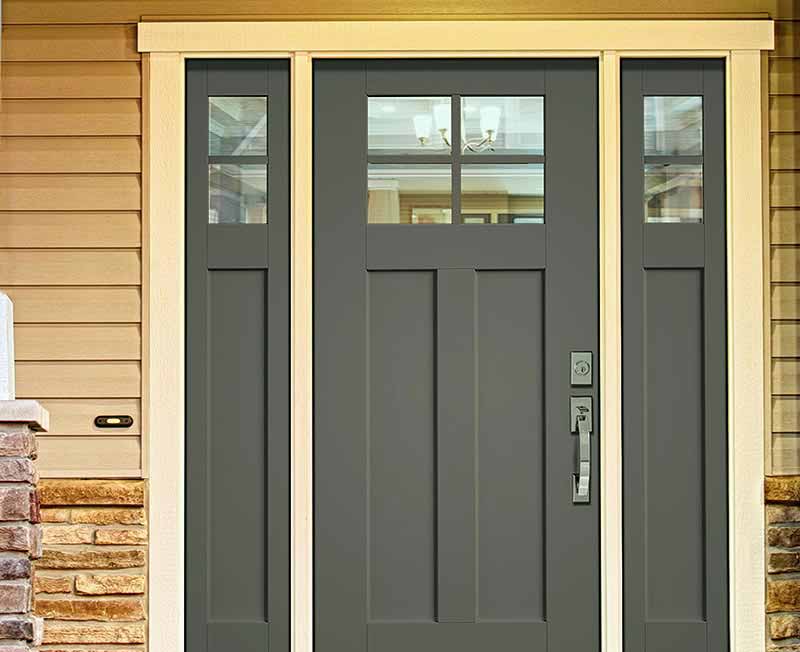 |
| Just the door, not the side lights. I like the hardware and the color, too. |
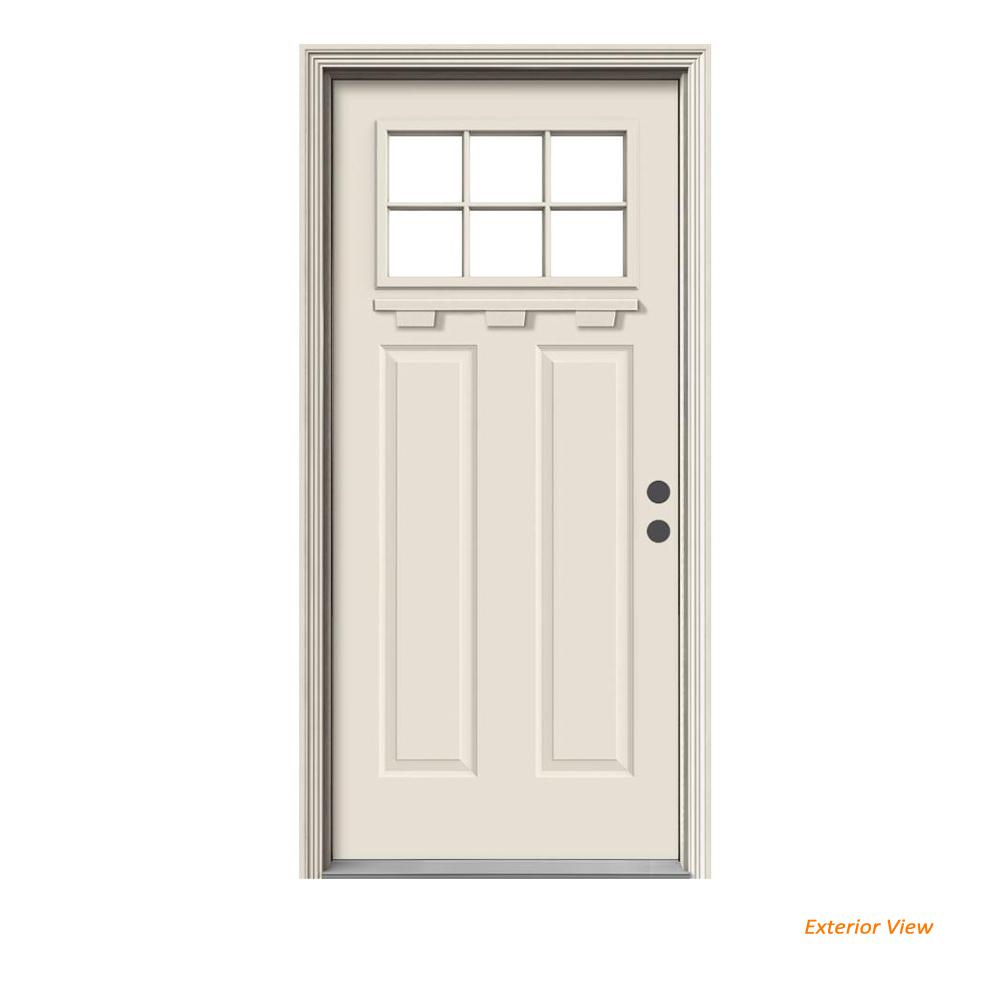 |
| Steel, pre-hung. Home Depot $490. |
 |
| Frank Lumber. |
I'm willing to consider other styles, perhaps mostly glass, or even solid/panel with no glass. It doesn't have to be Craftsman, but I think that would work.
As for hardware, Baldwin calls this Minneapolis sectional (as opposed to full or 3/4 escutcheon).
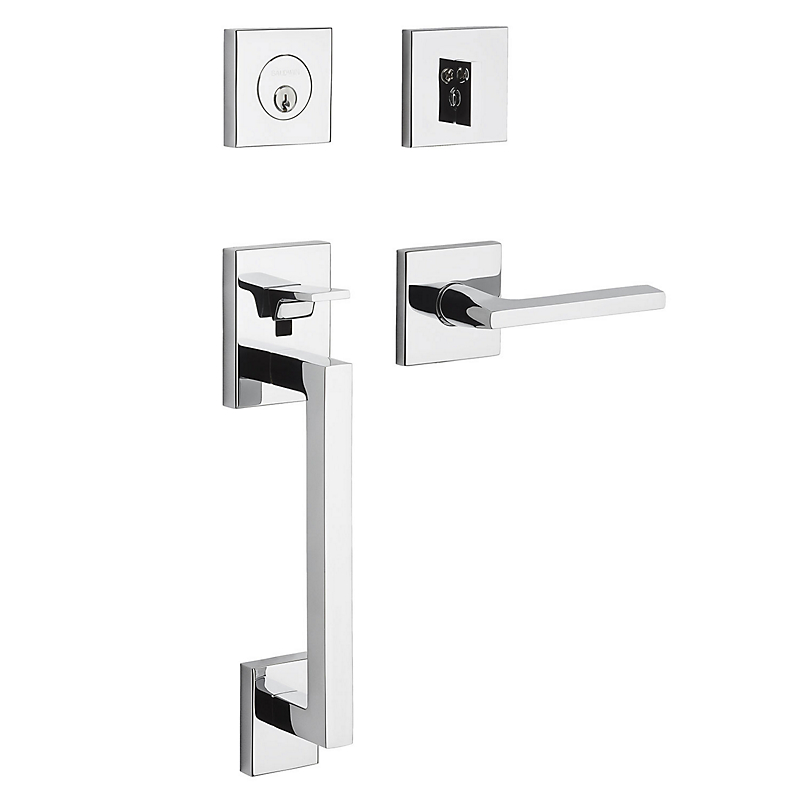 |
| Picture it in Satin Black--the Baldwin site can't. |
 |
| Frank Lumber, again. |
Latest Deck Layout

Trex (or equiv.) needed (16) 8' boards, (36) 14' boards, and (14) 20' boards = 912 LF (~$4,560).
Note, 18' 6" is silly--make it 18' for the sake of the structure. Then, the 45-degree part is arbitrary. The Trex is almost the same if it was square, so we could enlarge the deck for little extra cost.
 |
| Picture horizontal cable railings (and the breezeway roof) |

Gutters and Paint
The roof edge is damaged. The fascia board is not sound in places, and I'm not sure what the flashing situation is. The gutters are not well-anchored everywhere; they are dented; they fill with debris every few months; and they drip when it rains. As calculated earlier, it's 257 LF of gutter with 8 outside corners and 2 inside corners. The 8 downspouts are okay, but they are dented as well.
I would advise a client to remove all the gutters, replace rotted fascia, repair the roof edge, paint the fascia, paint the eaves, then install all new gutters with leaf guard tops, and only then paint the walls. An old bid from LeafGuard (tm) suggests new gutters would be $13,000. (Cheap vinyl gutters from Lowe's total about $600 in materials.) I am really reluctant to remove the gutters--just the demo and hauling is a big expense, and the gutters protect the house. It's a spring-loaded expense: Pay to remove them to increase pressure to spend even more money replacing them.
The question is: Are the gutters good enough if the plan is to make the house look attractive enough to sell? I think they are, with specific improvements. I need to add gutter guards, for one thing. Likewise, the eaves are in pretty good shape--they get the least exposure to the elements--and I want to leave them bright white.
The photo above illustrates the problem of designing a painting plan: What gets the main color and what will contrast? We have:

 |
| The green is now Acier and the ugly wires (upper left) are gone. |
The question is: Are the gutters good enough if the plan is to make the house look attractive enough to sell? I think they are, with specific improvements. I need to add gutter guards, for one thing. Likewise, the eaves are in pretty good shape--they get the least exposure to the elements--and I want to leave them bright white.
 |
| There are two shades of blue (also, the darker blue is more semi-gloss) |
- Vertical siding (Bright white)
- Horizontal siding (Blue)
- Chair rail (Darker blue)
- Door/Window trim (Blue)
- Garage doors (Bright white)
- Garage door trim (Darker blue)
- Downspouts (Blue)
- Gutters (Blue)
- Fascia board (Blue)
And bright white eaves.
 |
| Acier, with no contrast |
The issue is: where do we want contrast in the exterior paint scheme? If we gray-wash everything, it's boring. I think the chair rail could be a pop of color--lime green, maybe--but I don't know about the roof edge, or the door/window trim. A classic is bright white with gray.
The garage doors represent an opportunity. Glass roll-up doors would instantly improve curb appeal, but they would cost $8,000, and the west-most door isn't needed.
A stake in the ground idea: Make the walls a neutral gray. Use a dark green for the chair rail, gutters and fascia, and a softer gray-green for the door/window trim. These elements will cast a green onto the neutral gray. Then hit the garage doors with a gray-green significantly lighter than the trim.
Okay, so this looks stupid. But I'm including it for the color swatches.
 |
| It shows a two-tone wall, but that's just the original contrast |
To play along at home, go to https://www.sherwin-williams.com/visualizer/. The Locator Number on the swatches correspond to the S-W color samples--each card is numbered sequentially, starting with 101, and the first color (farthest from the hinge) on each card is C1.
This is slightly different:
- Vertical siding (Repose Gray SW7015 244-C1)
- Horizontal siding (Repose Gray)
- Chair rail (Overt Green SW 6718 149-C5)
- Door/Window trim (Snowbound SW 7004 256-C2)
- Garage doors (Spinach White SW 6434 270-C2)
- Garage door trim (Overt Green)
- Downspouts (Repose Gray)
- Gutters (Overt Green)
- Fascia board (Overt Green)
And bright white eaves.


Wednesday, April 1, 2020
Lighting the house numbers
Moving the house numbers to the kitchen wall makes it clear that this is one house. The main problem is that that wall is dark at night.
First plan was simple: Install an outdoor outlet, tapped into some basement circuit, then buy a low-voltage garden lighting kit, hang the transformer on the house and point a 12V light up at the numbers.
When I bought the outdoor outlet (weatherproof box, weatherproof cover, GFCI outlet, silicone sealant = $45.67 with tax; the outlet is $20), they were selling 120V LED spike lights. Transformers are ~$70, so $12 for the single light that I needed sounded good.
 The only problem (and I have to admit I didn't think about this right away) is that the light would be on all the time. The timer was on the low-voltage transformer I didn't get.
The solution (for now) is to just wire the outlet to the post light power. Instead of a general-purpose always-on outlet, we'll have one that only has power dusk to dawn. If we go the low-voltage garden way later, we can convert this to always-on simply by attaching it to a basement outlet instead of the post light.

The underground feeder gets its power in this box. By attaching the new outlet here, anything plugged into the outlet will have power only at night. (By the way, you can see the original post light power cable (black) running above the box. I should probably remove that.
So, first night. 550 lumens is too bright, perhaps. It's a flood and maybe it should be a spot--we don't want to call attention to the gas meter and the eaves. (Maybe moving it farther away would help.)
The other problem is that the numbers are too high on the wall and too small.
 |
| Lit-up house numbers |
When I bought the outdoor outlet (weatherproof box, weatherproof cover, GFCI outlet, silicone sealant = $45.67 with tax; the outlet is $20), they were selling 120V LED spike lights. Transformers are ~$70, so $12 for the single light that I needed sounded good.

The solution (for now) is to just wire the outlet to the post light power. Instead of a general-purpose always-on outlet, we'll have one that only has power dusk to dawn. If we go the low-voltage garden way later, we can convert this to always-on simply by attaching it to a basement outlet instead of the post light.

The underground feeder gets its power in this box. By attaching the new outlet here, anything plugged into the outlet will have power only at night. (By the way, you can see the original post light power cable (black) running above the box. I should probably remove that.
So, first night. 550 lumens is too bright, perhaps. It's a flood and maybe it should be a spot--we don't want to call attention to the gas meter and the eaves. (Maybe moving it farther away would help.)
The other problem is that the numbers are too high on the wall and too small.
Subscribe to:
Posts (Atom)
Steps Project
I want to remodel the whole front yard. New hardscape, and so on. But at the moment, my path from the driveway to the house is only barely w...

-
Here's the massing of a garage at 15-degrees and an apartment above it. I have modeled stairs up each side of the 20x20 cube, because ...
-
The A.10 kitchen still isn't working. Need to establish requirements for the kitchen. It has to be impressive, or buyers will notice the...
-
 Anxious to make some forward progress, I thought, "What if I painted the garage?" If I decide to extend the garage, then some of...
